08NPWT · Wound Therapy
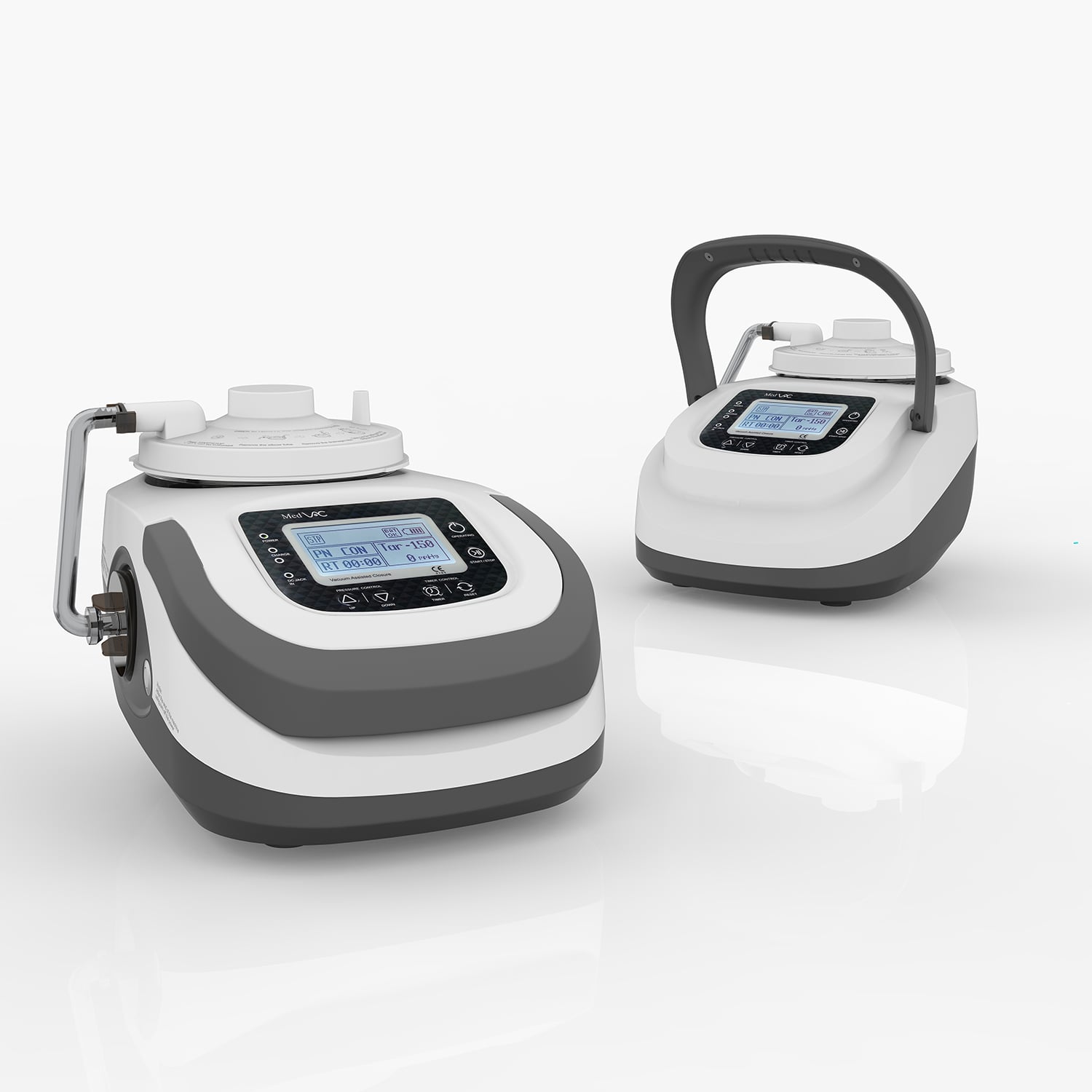
Medical Vacuum NPWT Pump
Microcomputer-controlled Medical Vacuum NPWT Pump.
Classification
Class II
NMPA Reg.
Lu Mech Reg. 20182140303
Microcomputer-controlled Medical Vacuum NPWT Pump with ultra-low pressure range, intelligent memory and multiple safety protections. Designed for chronic, acute and post-surgical wound drainage in inpatient and ambulatory settings.
KEY FEATURES
What makes it work.
- Continuously adjustable pressure: −50 to −450 mmHg, 10 mmHg steps
- Continuous and intermittent operating modes
- Quiet operation: < 45 dB
- AC/DC + spare battery (4 h continuous, 8 h intermittent) + 12 V vehicle DC option
- Auto memory of last setup, gas-leak alarm, overflow alarm, overheat protection
- Suction flow 1.5 – 8.0 L/min, ±0.2% pressure display error
APPLICATIONS
Where it's used.
- Acute wounds
- Chronic and diabetic wounds
- Wound drainage of high-exudate post-surgical wounds
CONTRAINDICATIONS
- Wounds with necrotic eschar or unfinished debridement
- Wounds with tumor tissue
- Sinus connected with organs
- Wounds with great vessels or organs exposed
SPECIFICATIONS
Technical specifications.
Classification
Class II medical device
NMPA registration
Lu Mech Reg. 20182140303
Pressure range
−50 mmHg ⇄ −450 mmHg, ±0.2% display error
Adjustment step
10 mmHg
Suction flow
1.5 – 8.0 L/min
Operation modes
Continuous · Intermittent
Noise
< 45 dB
Lifetime
> 10,000 hours continuous
Power
AC/DC + spare battery + optional 12 V 5A vehicle DC
Patent
ZL 2011 30150021.9 (utility); 20150379238.4 (invention)
Patents
Utility ZL 2011 30150021.9
Appearance ZL 201430202321.0
Invention 20150379238.4
FROM VEMERIX INSIGHTS
Market analysis behind this product
Buyer Guide
When NPWT Dressing Kits Are Not Interchangeable Across Pumps
Why FDA 510(k) indications for use, CMS integrated-system billing rules and product code OMP dictate companion-pump matching rather than catalog-universal claims.
September 13, 2026 · 14 min read
Evidence Review
Wound Debridement Before the Vacuum: What Medicare Data Shows About Where NPWT Actually Sits in Care (2026)
Medicare professional-service data and current wound guidance show why debridement and dressings define the pathway—and why NPWT remains a selective downstream adjunct.
August 17, 2026 · 28 min read
Buyer Guide
Single-Use vs Reusable NPWT Pump: A Disposable-vs-Powered Procurement Decision Matrix Built on FDA Product Codes, HCPCS Reimbursement and Per-Episode Cost
The FDA itself splits NPWT into reusable powered, non-powered mechanical and disposable powered single-use pumps under three different Class II product codes, and the right buy flows from exudate volume, wound complexity, care setting and reimbursement path rather than a blanket claim that disposable is better.
August 8, 2026 · 16 min read
Buyer Guide
What the FDA 510(k), Recall and MAUDE Record Reveals About Negative Pressure Wound Therapy Pump Failure Modes — and What Procurement Teams Should Specify Against (2015–2025)
An original FDA surveillance analysis of 214 powered NPWT pump clearances, 48 recalls, and 5,775 MAUDE adverse-event reports (2020–2025) translated into tender acceptance criteria and supplier-vigilance questions.
August 6, 2026 · 15 min read
Evidence Review
Incisional vs Open-Wound NPWT: When Closed-Incision Evidence Cannot Be Generalized to Chronic and Open Wounds
A comprehensive clinical evidence review for perioperative, clinical-engineering, and procurement committees establishing why trial outcomes for prophylactic closed-incision NPWT cannot be directly transferred to open or chronic wound care.
August 5, 2026 · 38 min read
Buyer Guide
NPWT Pump Hospital Price and Total Cost of Therapy: A Transparent Pump, Consumables, Reimbursement and Downtime Cost Model (Without Inventing Vendor Prices)
A hospital procurement cost model separating public reimbursement signals, tender price ranges, and consumable consumption rates from editorial cost scenarios, without inventing vendor quotes.
August 5, 2026 · 25 min read
Evidence Review
Negative Pressure Wound Therapy Dressing Selection: What the PVA-versus-PU Foam, Pore-Size and Closed-Incision-versus-Open-Wound Evidence Actually Supports
Navigating NPWT dressing selection requires separating material mechanics from clinical healing claims—evaluating open-pore PU black foam (400–600 µm) for high-exudate granulation against hydro-retentive PVA white foam for sensitive wound beds, respecting the 48–72 hour open-wound change boundary, and understanding the FDA regulatory divide between open-wound (OMP) and closed-incision (QFC) devices.
August 3, 2026 · 15 min read
Buyer Guide
How to Specify a Negative Pressure Wound Therapy (NPWT) System: A Lot-by-Lot Tender, RFQ & Acceptance Checklist for Pumps, Dressings and Canisters (2026)
A hospital procurement, health-system category management, or distributor team specifying negative pressure wound therapy (NPWT) should not issue a single bundled RFQ. Structure tenders into platform lots (acute heavy-duty, portable ambulatory, single-use/disposable, consumables, rental), map every pump performance and alarm requirement directly to documented FDA failure modes (leak, occlusion, canister overflow, power thermal cutoff), and demand a 6-part regulatory evidence pack (510(k), UDI, ISO 10993, IEC 60601-1, EO sterilization) before awarding volume.
August 3, 2026 · 18 min read
Market Analysis
From the Pump Cart to the Pocket: The Disposable Shift in Negative-Pressure Wound Therapy
How wound care is repeating the move from a durable capital device to a registered single-use consumable — and why the recurring disposable kit, not the pump, is the strategic prize for device makers and distributors.
July 1, 2026 · 31 min read
MORE IN NPWT
Related products
Ready to evaluate NPWT Pump?
Sample units typically ship under 10 business days for qualified buyers. Distributors — ask about territory exclusivity.